

Automate the Predictable; Humanize the Exceptional
How Product-Led Growth Lays the Foundation for AI Go-To-Market

What You’ll Learn in This Article
PLG is the scalable system for modern go-to-market (GTM); AI rides on those rails.
Systematize routine work for efficiency; deploy humans where judgment creates outsize impact.
Growth comes from compounding micro-optimizations, not one-off heroics.
The Bowtie and cohort-based experimentation provide the framework to optimize a product-led GTM.
The future of GTM is human + machine, operating within the same system.
On a Tuesday morning in 2017, I pulled into a parking spot outside my dentist’s office, early for my appointment, but just in time to dial into an executive meeting, where I was expected to contribute. When I looked at the meeting invitation on my phone’s calendar, I realized our company had recently switched from GoTo Meeting to Zoom, and to my discredit, I had not yet created a Zoom account nor installed the app on my phone.
“Great,” I thought, “once again I cut it too close, and I’m going to miss the beginning of this meeting.”
I knew from past experience that installing a video conferencing app was a pain on a laptop—let alone on a phone. And who knew how much more difficult it would be if I didn’t have an account set up?
Fifteen seconds later I was on the call—fully dialed in, with perfect video and sound.
“What?”
“Video conferencing never works that well. Especially on a mobile phone!”
What I experienced that morning wasn’t just convenience—it was product-led growth (PLG) in action.
At the time, video conferencing was a two-player race, with virtually every corporation in the world standardized on either WebEx or GoTo Meeting. Zoom was competing with BlueJeans, Skype, join.me, and a host of other smaller players. We all know what happened next.
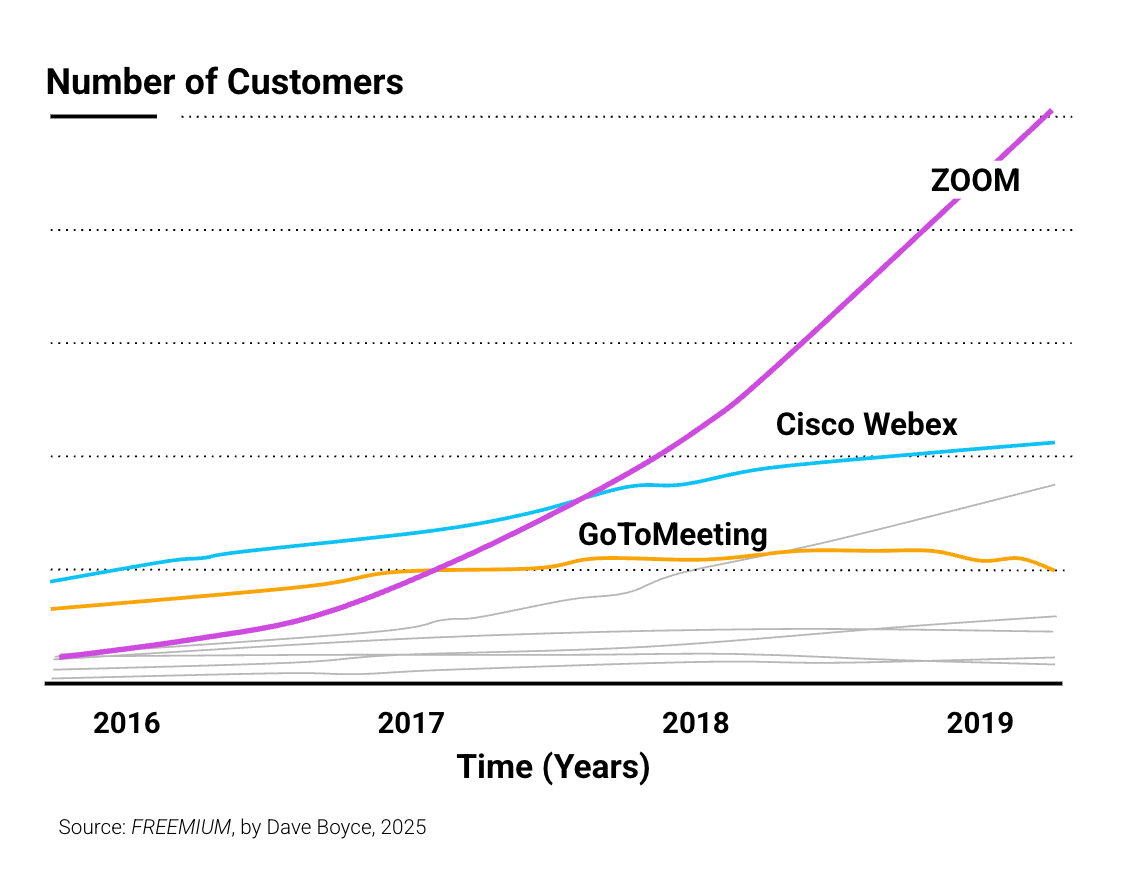
Figure 1: Videoconferencing Software Market, 2016-2019
Zoom’s takeover came from its ability to automate and simplify painful adoption steps.
This was part of a self-service revolution that began with Atlassian in 2003 and gave birth to over forty future public companies, including Dropbox, Docusign, Twilio, and GitLab. The strategy came to be known as product-led growth, or PLG.
“Product-led growth is the de-laboring of the GTM process.
It’s about making it as easy as possible for users to find, understand,
adopt and achieve value with a product, without the need for a lot of
manual intervention from sales and marketing teams.”
-OpenView Partners
Now fast forward to 2025… My family and I were driving from Utah to Seattle to visit our son at the University of Washington. I needed to cancel a service with my cell phone provider, so I used the car time to dial the customer service number. My family heard only my side of the conversation:
“Existing Account.”
“Mobile.”
“No.”
“Speak to an agent.”
“Existing account.”
“Speak to an agent.”
“Speak to an agent.”
“Speak to a human agent!”
For all the work I’ve done on self-service and automated GTM, it was ironic that I couldn’t get around an automated workflow to speak to a human when I needed to.
The cellular provider was attempting to automate something that has historically been painful—and failing.
We all know when automation works and when it doesn’t. When it works, it just works—seamless, hassle free, and beautiful, like my Zoom experience in 2017. And when it doesn’t, it turns Kafkaesque: experiences trying too hard to be human but with all the charm of a creepy, humanoid robot.
Doing automation right means providing the customer with choice. When it’s more convenient to go it alone, let the customer go it alone—like when you’re still getting your bearings at a retail store and tell an associate you’re “just looking.” But sometimes it’s quite helpful to speak with a human—for instance, if you need to walk out of the store with a gift, and you’re out of ideas—then we need that choice, too.
The real goal is to:
“Automate the predictable, so you can humanize the exceptional.”
-Will Guidara
In his book, Unreasonable Hospitality, Will Guidara writes about exceptionally human experiences in hospitality that go far beyond any reasonable expectation on behalf of the guest. He cites the example of hosting a couple at a restaurant to celebrate their anniversary and presenting them at the end of their meal with a custom photo album created with photos taken throughout the evening.
These opportunities to display “unreasonable hospitality” at certain moments in the customer journey can surprise, delight, and build tremendous loyalty. But Will knows as well as we do that this is only possible if the bulk of your processes are systematized. If the predictable portions of the customer journey run themselves, with little need for cognitive load, creativity, additional cost, or extraordinary effort, only then we can afford to concentrate on the moments where unreasonable efforts can truly make a difference.
This Moment in SaaS
Right now it doesn’t feel like we can accommodate “unreasonable hospitality” in the SaaS industry. Shareholders are demanding we get back to growth, insisting that at least 20 points of our “Rule of 40” be delivered via growth. We can barely afford the sales teams we already have, much less build in capacity for unreasonable hospitality. Marketing isn’t filling the funnel with leads like it once did, but we can’t throw more money at that either. The easiest place to cut GTM costs is in customer success, but a) we’ve already done that, and b) that’s not exactly a path toward growth. As an industry, we are growing at half the rate and paying about 60% more per unit of growth than we once did.
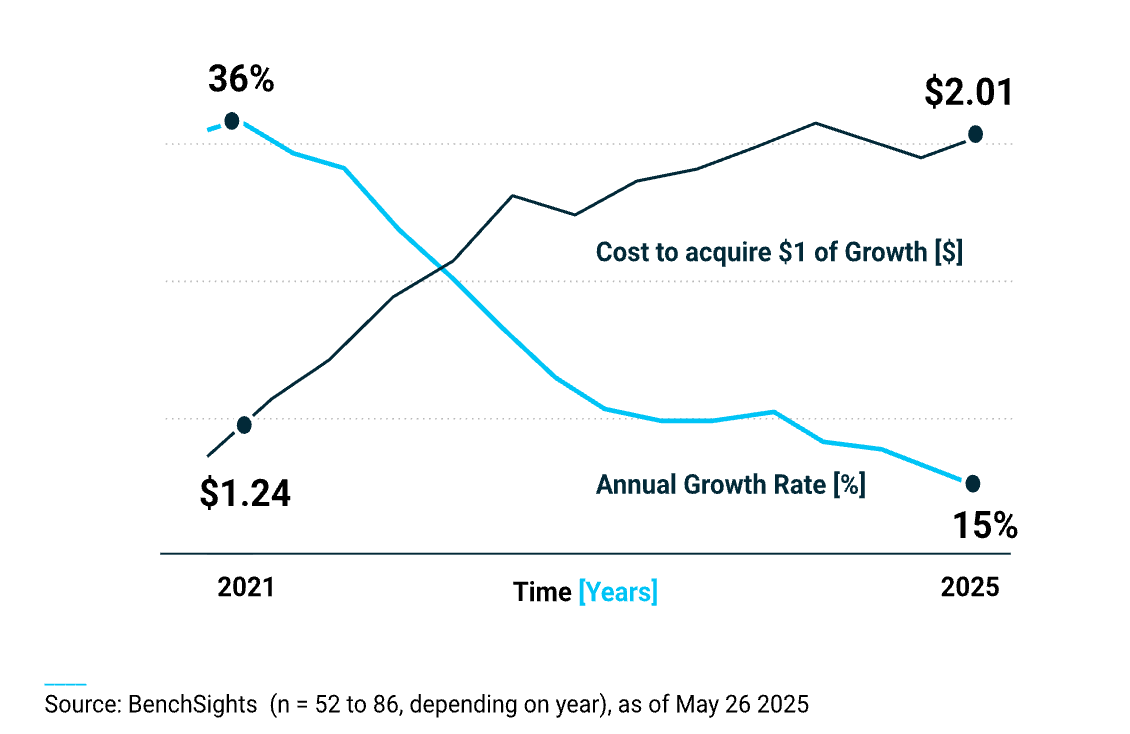
Figure 2: From 2021 to 2025, the cost to acquire $1 of growth nearly doubled, while actual growth dropped by more than 50%
To make matters worse, each time we achieve growth and our base of customers and ARR becomes larger, it seems to get harder, not easier, to sustain growth rates.
The worsening economics of SaaS stand in stark contrast to the gravity-defying growth we see from newly-minted, AI-native companies, including Cursor, Lovable, and Replit. These companies are scaling at rates never before seen, and they are doing it without adding headcount at all. Lovable was the fastest ever company to go from $1-100M in ARR, and Cursor surpassed $500M ARR with fewer than 100 people on payroll.
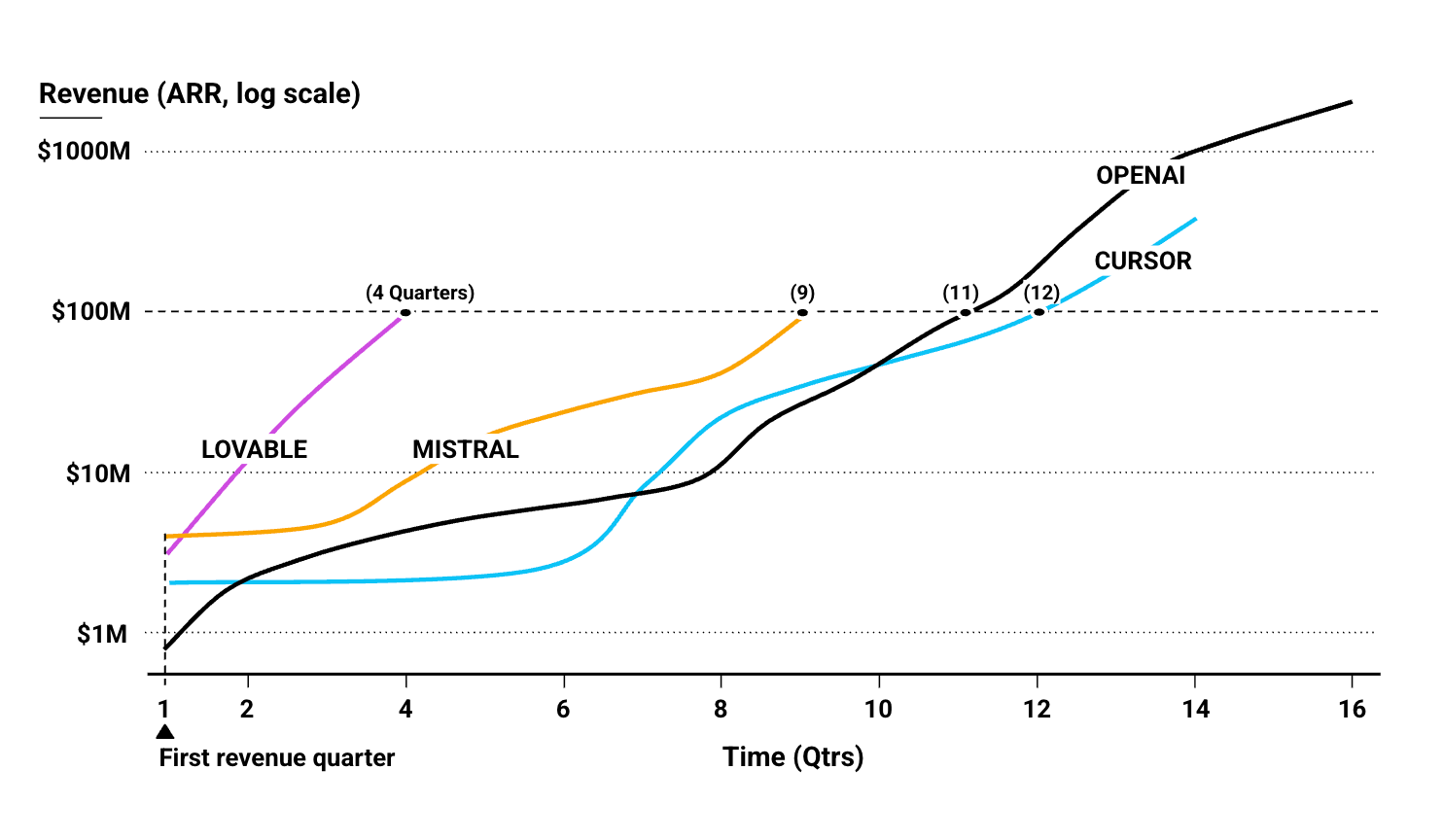
Figure 3: Quarterly ARR Growth (logarithmic scale) for AI-native companies
If most SaaS companies are struggling to grow, but AI-Natives are growing quickly, what are the AI-Natives doing that SaaS-Natives are not? How are they growing without adding headcount? Is there anything we can learn?
Is AI-native success due to being AI companies? (If that is the answer, it’s not helpful for the 99% of companies who are not AI-Native.)
Yes, the tailwinds these companies enjoy stem from being in the AI space. But the mechanics that allow them to scale quickly are the mechanics of PLG.
What Can We Learn from Product-Led Growth?
I recently published a book called FREEMIUM: How Zoom, HubSpot, Atlassian, and Other Top Companies Use Product-Led Growth … for Low-Cost Customer Acquisition and Expansion. The book explores the growth journeys of companies that paved the way for automated GTM—names like Atlassian, Slack, Dropbox, and Zoom, all of which set new marks for being the fastest-growing companies up to that point in history.
Figure 4 is a chronological accounting of the fastest-growing pre-AI software companies of their time.
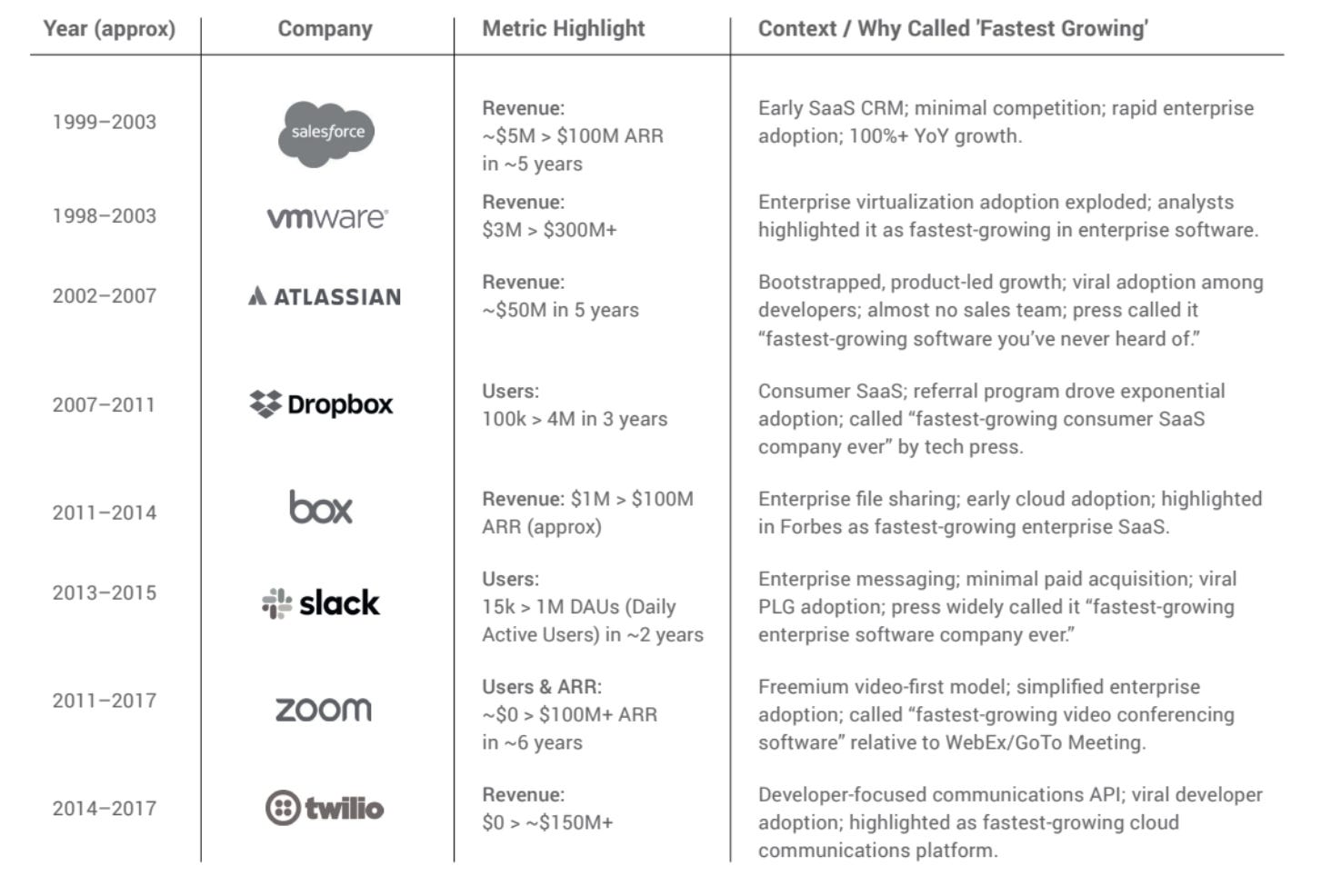
Figure 4: Fastest-Growing Software Companies Chronological Leaderboard (Pre-AI)
The first two growers, Salesforce and VMware, went to market using a sales-first approach.
But beginning with Atlassian in 2003, every single “fastest ever” company used product-led growth as their primary GTM motion—especially in the early years of their growth.
Many of these companies sustained their high growth rates, even after reaching revenue in the billions of dollars. Atlassian (see Figure 5) grew 30%+ every year for 30 years, even as they approached and exceeded $3B in revenue. This seems to defy the norm of it being more difficult to grow, the larger your customer base becomes. Today, Atlassian is a $45B market cap company.
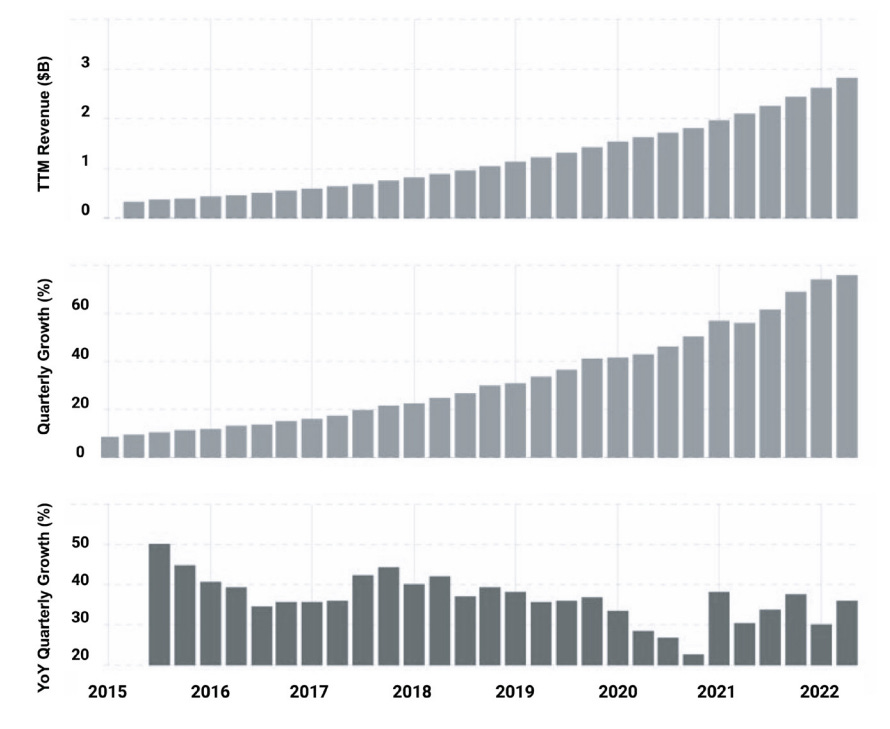
Figure 5: Atlassian’s Sustained and Consistent Growth
First Principles of Product-Led Growth
When I first used Bill.com, I was only looking for one thing. I needed to create an invoice that would include the option to pay by electronic funds transfer. I was wary. I expected complexity and complicated configuration workflows. Instead, I created an account, connected my bank, built an invoice, and within five minutes sent it to a client. Voilà. Later, I explored more advanced features, but that first moment made a lasting impression—I was able to accomplish what I came for almost immediately—no muss, no fuss.
A fundamental truth of all PLG products is that they are built for the end user, not the buyer.
In many traditional B2B businesses, software roadmaps skew toward the needs of buyers (executives with budgets and authority), not the humans who actually use the tools. Software development teams can easily direct half or more of their engineering effort toward platform-level features like compliance, permissions, and admin dashboards that benefit the buyer and do little for the end user’s day-to-day experience.
But PLG companies never lose sight of the user. They understand that recurring revenue is the result of recurring impact, and recurring impact is the result of usage. With this in mind, PLG companies optimize for ease-of-use, beginning with the initial setup and continuing through daily, weekly, and monthly active usership.
The first principles of product-led growth that facilitate this user-first approach are: empathy, generosity, and metrics.
1. Empathy: Get to Know the User and Her Job to be Done
Empathy means deeply understanding the end user—what she cares about, how she experiences her work, and what progress she’s trying to make. Clayton Christensen’s Jobs to Be Done (JTBD) framework is useful here: in what situations would it make sense for someone to “hire” your product to help them move forward?
I worked with a WhatsApp chatbot provider that served large corporations well. But when we interviewed very small businesses, we discovered their needs were different: customer conversations often began on Instagram (not WhatsApp), their use cases were narrow and specific, and they distrusted AI bots. By shadowing them in their shops and prototyping alongside them, we identified the two daily jobs that mattered most, and we built a simple solution that they loved.
That required getting out of our own heads, deprioritizing our assumptions, and practicing empathy.
2. Generosity: Deliver Value Before Extracting Value
Once we understand the user’s job, we offer to help by providing access to the product to help accomplish her JTBD:
Us: “Oh! That’s what you’re trying to accomplish? Here—see if this can help.”
Customer: “What do I owe you?”
Us: “Nothing.”
Customer: “When do I pay you?”
Us: “Never.”
This was the hardest thing to get my head around when I moved from Boston to Silicon Valley in 2010. Whole companies were building enterprise-level functionality into their software and then giving it away: Dropbox, DocuSign, Mailchimp, Yammer, Zoho. Whereas I had been selling Oracle software licenses that averaged $1.2M in ARR, these products had entry-level tiers that were literally free forever. Beyond these products, Atlassian, Zendesk, and Twilio were also offering free access to their solutions—albeit on a limited trial basis.
PLG flips the traditional model: instead of selling first and delivering impact later, PLG products deliver impact before purchase.
Seek first to create value, then to extract value.
It’s not exactly true that the customer will never pay for the solution. Atlassian is a $45B company based on mastering the art of charging money for products that initially were free to try. As users achieve impact, they become fans. As their needs grow, they upgrade. Monetization is architected into the solution as a natural part of a customer journey that begins with generosity.
3. Metrics: Track Everything
Since no salesperson is in the room when the user signs up, activates, or begins using the product, PLG solutions must be instrumented to measure the journey. Every click and every feature interaction generates data—signal—that indicates what’s working, what’s not, and where users may be getting stuck.
Metrics allow product managers to spot friction, design experiments, and iterate. Growth is rarely about one big change—it’s the compounding effect of hundreds of small optimizations.
“PLG companies maniacally focus on metrics that quantify user value and user experience, and optimize for those in the knowledge that they are leading indicators for future monetization.”
-Ben Williams
The metrics I emphasize in FREEMIUM fall into two broad categories:
User Experience Metrics
These answer questions like: Where are users getting stuck? What percentage of new users reach “first impact” (the moment of real value creation) within their first session? Which features drive repeat usage? Activation rate, daily or weekly active users, and feature adoption rates are leading indicators of future monetization.
Financial and Retention Metrics
Because PLG companies scale through usage, the most powerful financial indicators are tied to retention and expansion. Gross Revenue Retention (GRR) measures whether customers stick; Net Revenue Retention (NRR) shows whether they expand. Best-in-class PLG businesses often exceed traditional SaaS benchmarks on these dimensions because their products naturally pull users deeper into engagement.
Other ratios—LTV:CAC (lifetime value to customer acquisition cost), CAC payback period, and the Rule of 40—still matter. But PLG companies also tend to outperform their sales-led peers on these benchmarks, precisely because acquisition costs are lower and expansion opportunities are built into the product’s workflows.
The PLG Bowtie as the Underlying Data Model
To structure these signals, Winning by Design uses a PLG adaptation of the Bowtie Data Model, which captures the stages of progression through a product-led journey. The PLG Bowtie organizes metrics across Discovery, Acquisition, Activation, First Impact, Habit, Monetization, Engagement, Retention, and Expansion.
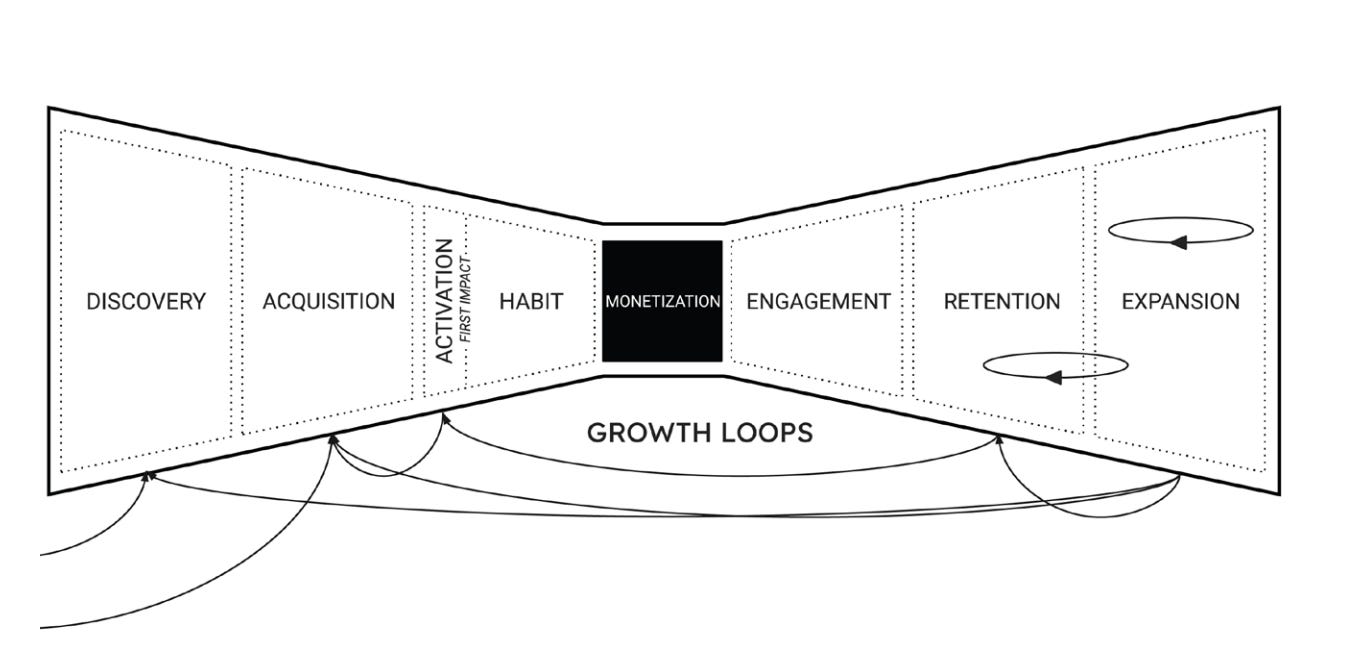
Figure 6: The PLG Bowtie
Discovery: user “clicks” on any marketing or product property
Acquisition: traffic-to-signup conversion (newly created accounts)
Activation: user begins to operate in the product
First Impact: user receives initial value
Habit: incorporation of product into regular activities
Monetization: conversion from free to paid tiers
Engagement: repeat usage frequency (e.g., daily active users, or DAU)
Retention: retention of recurring revenue
Expansion: expansion of recurring revenue
The Bowtie reframes the journey not as a funnel that ends at purchase, but as a journey that continues through retention and expansion. It also encompasses recursive loops, in which existing users recruit new users into the system. Each stage is measurable, and each depends on the health of the stage before it.
Using the Bowtie and Cohorts as an Experimental Framework
Growth for PLG companies is rarely driven by a single big launch. More often, it is the compound effect of hundreds of small optimizations. Every new onboarding tweak, every simplified workflow, and every clarified call-to-action compounds into measurable growth.
These improvements are tracked and optimized via growth teams—teams specifically built to focus on growth objectives (e.g. “retention” or “activation”). Growth teams consist of approximately five to seven people including product, marketing, and engineering—all within the same team structure.
Figure 7 represents the work of a growth team tasked with optimizing usage retention., Cohorts of new users are tracked in rows: the first row represents the “January Cohort,” the second row represents the “February Cohort,” etc. The percentage of users still active is tracked over time, shown by the percentages in the cells to the right. In this example, the cohort of users who began in January was still 71% active at the end of month one, 21% active at the end of month six, and only 11% active by the end of month twelve. As the team makes improvements to the product, they are able to retain more and more active users. The July cohort retains 82% active users by the end of month one and 48% by the end of month six—a marked improvement.
Because growth teams are objective-focused, rather than product focused, they can use any means at their disposal to improve their target metric. In this case, the metric is usage retention, and the growth team could theoretically run any experiment they could think of including better experiences within the product, such as onboarding and usage. But also fair game would be to experiment with tighter ICP definition, different acquisition campaign messaging, or trigger-based human intervention to assist users when appropriate.
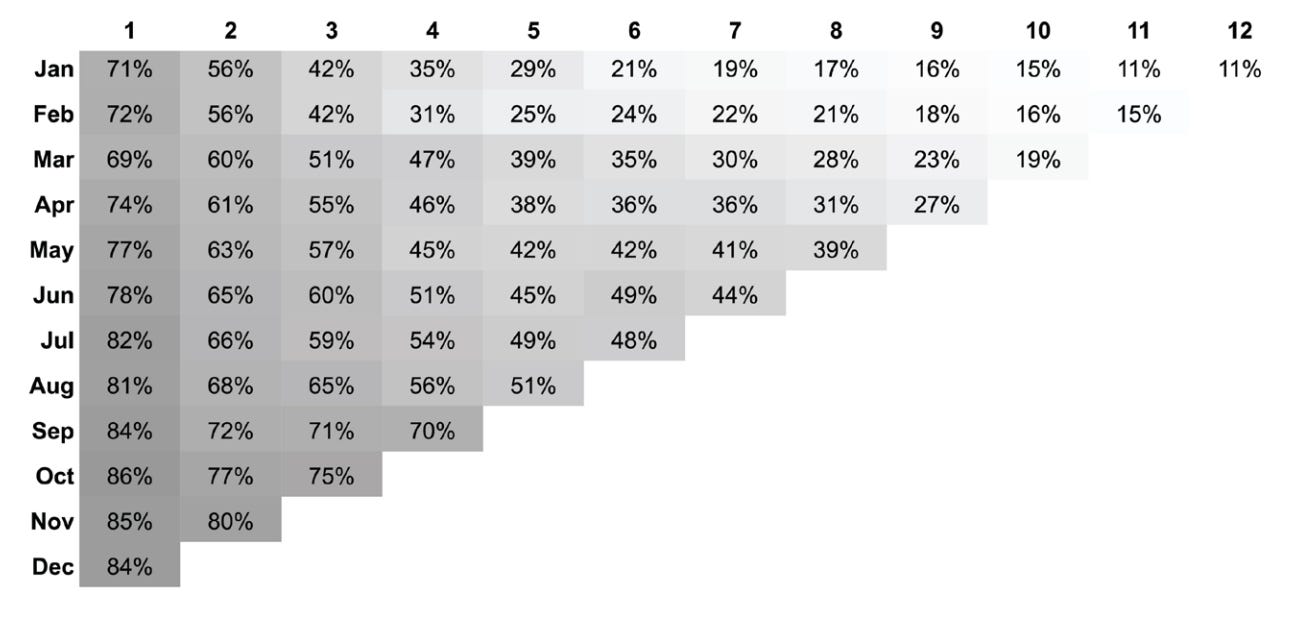
Figure 7: Usage Tracking by Cohort
Metrics are not an afterthought in PLG—they are the nervous system of the business. Without them, PLG is guesswork. With them, we can turn an automated GTM motion into a scalable system for growth. Instrumentation and signal collection tell us how the architected revenue system is performing, and we use these signals to tune all parts of the customer journey. Small improvements and corrections ensure we have a high-performance, highly repeatable, highly scalable revenue factory. The Bowtie serves as a data model to tie it together, creating a system where revenue always follows impact.
Applying PLG in the Age of AI
Product-led growth built the rails for automated GTM. In a PLG framework, self-service customer journeys can be architected, built, tested, and optimized. The reason every “fastest-growing” SaaS company since 2003 has been PLG is that they are built on a system that can scale at whatever pace demand will support. This system is not constrained by how quickly a company can hire and train sales or CS people—those jobs are done by machines that can scale infinitely.
To be clear, all of the “fastest-growing” PLG companies also have sales and CS teams. But they didn’t architect sales or CS into the process as a necessity. They built in human assistance as an option, to be applied only if and when such assistance can accelerate the customer’s path to impact. The default is the “self-service happy path,” and the exception is human assistance. Ideally, this would be at the customer’s discretion, e.g.,
When would I rather work with an AI agent?
(outside of business hours, in my own language, or when I want to avoid the quota-driven behavior of a salesperson)
When would I rather work with a human?
(if I have a large-scale change management, approval, or stakeholder management issue on my hands)
And when would I rather just get my hands on the product?
(traditional PLG, where I try before I buy)
Now fast forward to an AI-first world, where the immense popularity of AI is creating demand, and the GTM motions of the leading companies are facilitating growth.
Each of the companies featured in Figure 8, including Lovable (fastest ever to $100M) and Cursor (fastest ever to $500M), has built these same core PLG principles into their GTM systems. This is how they are able to scale without adding headcount. This is how they take the tailwinds of AI popularity and turn them into scalable monetization.
Empathy defines how the product is designed
Generosity informs contracting structures (often pay-as-you-go)
Metrics allow for rapid iteration and improvement
Usage metrics
Revenue metrics
To date, almost all hypergrowth in the post-AI world runs on PLG rails. This is no accident. These hypergrowers are built by PLG-Natives, whose default assumption is that humans are not needed to facilitate the purchase, usage, or monetization of their products. Figure 8 showcases examples of the PLG heritage that is “built in” to the GTM teams of hypergrowth AI-Native companies.
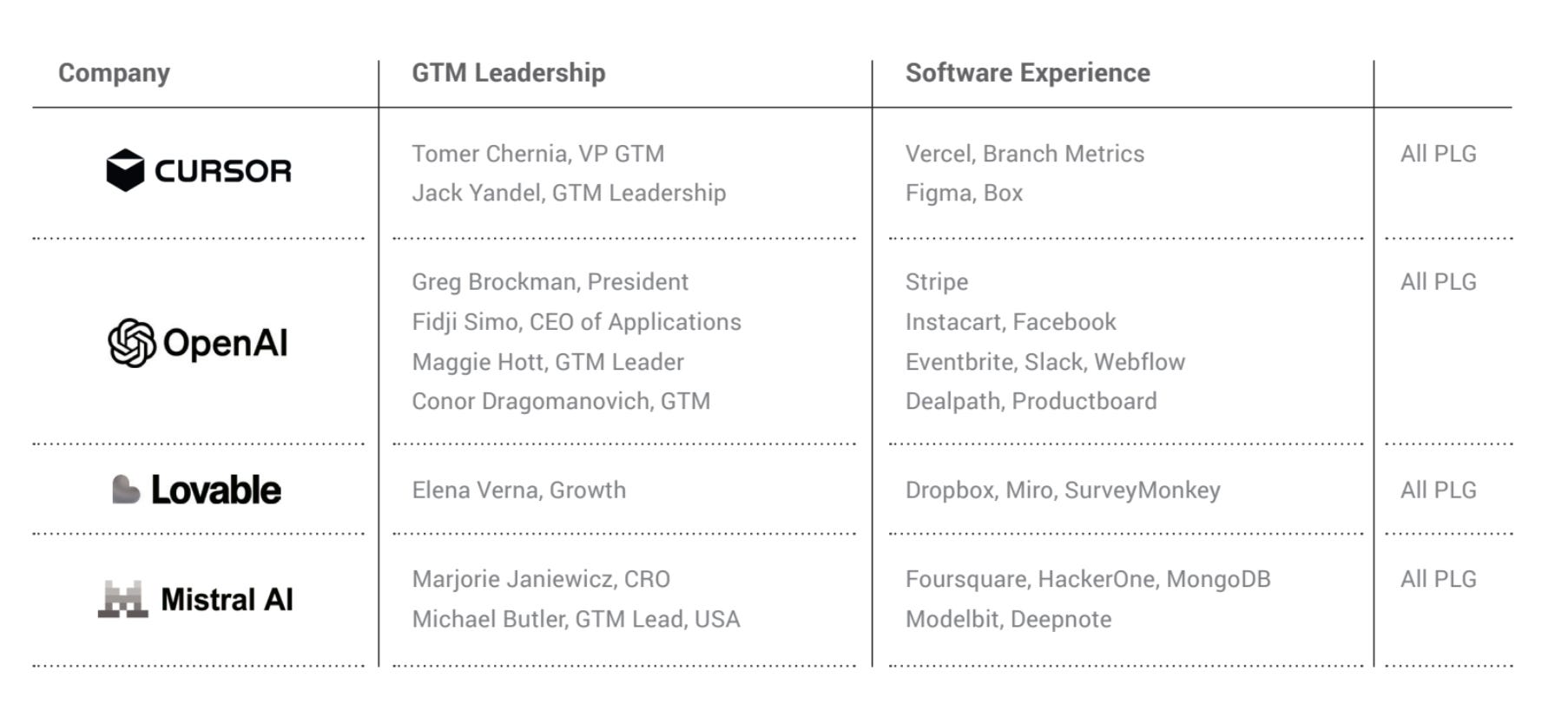
Figure 8: PLG Background “Built In” to AI-Native GTM Leadership
But What About AI GTM?
“Okay, so AI-Native companies have built their GTM on PLG rails. But what about the promise that AI holds to automate tasks and roles formerly performed by humans?”
AI has the potential to automate more of the GTM process than even PLG could. Agents can take on more complex tasks and replace even more human roles—in theory. We believe in a future where this happens—AI makes the complex simple and the “enterprise” PLG-able. But all of this must happen on PLG “rails.”
In the rush to embrace AI GTM, many operators have assumed that “off-the-shelf” agents could replace human tasks without defining the GTM process, without defined playbooks, and without an operating system. This was unreasonable. While AI is good at language, reasoning, and performing tasks, AI cannot learn what you don’t teach it. Think about what it takes to teach a human to do a task within your GTM. You don’t need to teach a human language, basic skills, or reasoning; she comes with education and experience that equip her to operate in complex environments. But you do need to teach her the system within which she needs to operate. Once she learns that, she’s off to the races.
If you already have documented processes, playbooks, frameworks, ICP definitions, rules of engagement, and other growth operating system parameters, training a new human will be easy. If not, she will learn on the job by asking lots of questions, observing her peers, and awaiting feedback from her manager. This can take time, and it produces variable results.
This is the same with AI agents. To get the most out of them, we need to have documented the growth system within which they will operate. Once they understand their assignment and objective, they will perform tirelessly and scalably. They will take on tasks that were formerly too complex for PLG to tackle. Agents have the potential to PLG-enable more than PLG alone ever could:
AI can turn complex products into simple ones
AI doesn’t just deliver a free trial, it walks you through it
AI can answer the “what now?” questions the moment you get stuck
AI can connect tools into your actual workflow so you see value fast
Even though the industry got ahead of itself with the deployment of AI agents to perform GTM tasks, once we define and document the processes of our growth systems, the power of AI to automate them will be staggering.
Does the Future of GTM Belong to Humans or Machines?
A question that arises in almost every conversation on the topic of automating GTM is whether this systems-driven approach (especially with AI) will replace humans.
The short-term answer is, “Yes, AI will replace humans.” But that isn’t exactly the right way to think about it. More accurate would be that, “AI will perform tasks that humans used to perform.” This is not the first time we have seen that happen. In the industrial revolution, plow operators became tractor operators, hand weavers became mechanical loom operators, and blacksmiths became factory machinists. Much later in 1930, British economist John Maynard Keynes warned that the economy of the time was “being afflicted with a new disease” called technological unemployment. Labor-saving advances were, he wrote, “outrunning the pace at which we can find new uses for labour.” At the time, machinery was transforming factories and farms. One of the most common jobs for young American women—telephone operator—was being replaced by mechanical switching. And in the context of the Great Depression and its accompanying 20% unemployment rate, the situation seemed dire.
Keynes predicted this would only be a “temporary phase of maladjustment.” He believed new jobs would emerge, and as a whole, employment would remain intact. Keynes, of course, was right. And the same logic applies to our current moment of AI. While tasks currently performed by humans will in the future be automated, the economy is most likely to figure out how to absorb the resulting labor surplus in productive ways. People will learn new jobs, new tools, and new processes, and the overall economy will benefit.
This brings us back to Will Guidara’s advice to, “Automate the predictable, so we can humanize the exceptional.”
What happens when 70% of new customers are able to onboard and achieve first impact without assistance?
When 60% of conversions to higher-paying tiers are automated?
When 90% of renewals fly though without a hitch?
Does that mean we have no humans? Fewer humans? Fewer humans per unit of ARR?
One thing is sure. In a world where more of the default tasks of GTM are automated, we can concentrate our human superpowers more precisely where they are needed—to manage unique, complicated, and nuanced situations, where human judgment and human courage are required.
So does the future of GTM belong to humans or machines?
Yes.
This article was originally published in GROWTH, by Winning by Design. Click the image to subscribe for free.
